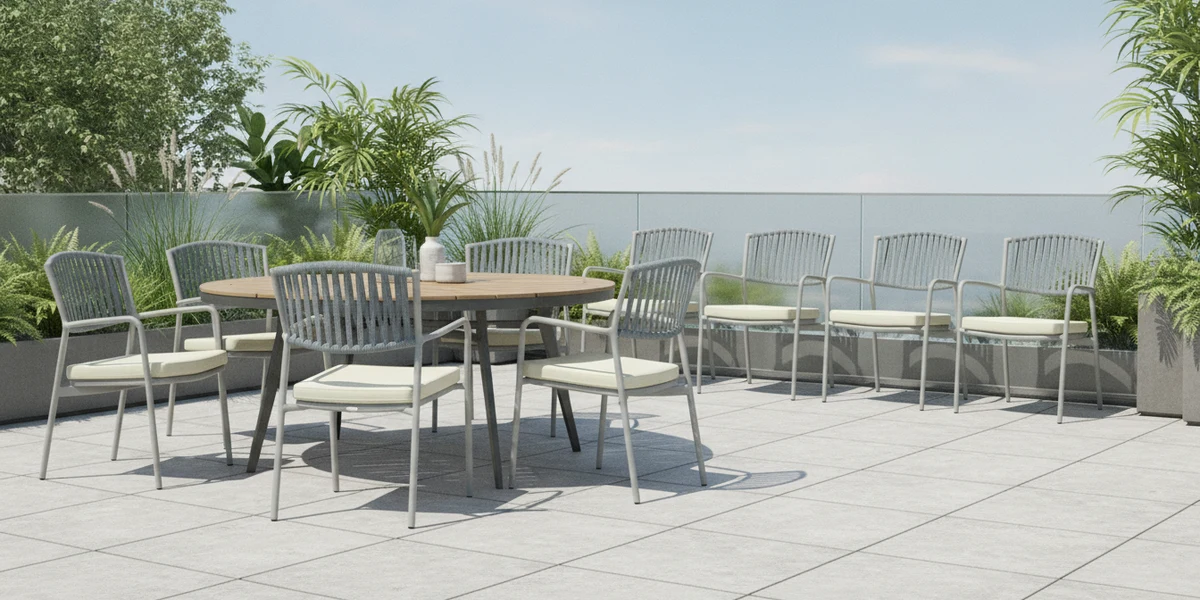
Do Metal Chairs Rust? The Importance of Cathodic E-Coating

Do metal chairs rust?
A metal chair will rust if it is not protected. The most effective way to protect metal against rust permanently is cathodic e-coating (KTL); this dip coating covers the metal surface electrochemically and protects it against corrosion from within. The electrostatic powder paint applied over the e-coating protects the colour and surface. Metal that is only powder-coated, without e-coating, may rust over time.
Why does metal rust?
Metal (steel) corrodes when it comes into contact with moisture and oxygen; this is the formation of rust. Moisture is constantly present especially outdoors, at the seaside and in frequently cleaned areas. When even the smallest scratch or pore forms on the paint surface, unprotected metal begins to rust from there and the rust spreads under the paint.
The insidious part is that rust does not start where you can see it. On a chair, corrosion is usually triggered at points hidden from view: the edge of a weld seam, the inner face of a tube section, the hole where a foot glide sits. These areas both trap moisture and are the last to dry. By the time the first blister appears on the surface, the layer advancing beneath the metal has already spread — the paint lifts because the rust under it gains volume and pushes it up.
For a venue this means one thing: whether a chair is genuinely suitable for outdoor use cannot be judged from the surface quality in its first season. The difference shows in the second and third year, particularly on furniture left outside through winter. That is why the protection has to sit beneath the paint and be applied during manufacturing — it cannot be added afterwards.
What is cathodic e-coating (KTL)?
Cathodic e-coating — technically cathodic electro-deposition (KTL) — is an industrial corrosion protection method in which the metal part is dipped into a special coating bath and coated homogeneously by electric current. Used on vehicle bodies in the automotive sector, this method reaches every point of the metal (including internal cavities), forming an invisible but strong protective layer.
The process is more than a single dip. The frame is first degreased and its surface prepared with a phosphate treatment so the coating will bond; only then does it enter the e-coat bath. The direct current applied in the bath carries coating particles towards the metal, and as each area becomes coated it turns insulating — so the coating naturally moves on to the points not yet covered. That is the secret of the uniform thickness: interior surfaces no brush or spray gun could reach receive the same layer. In the final step the part is oven-cured to harden the coating.
At Miles Sandalye, all metal products first go through this e-coating process, then are coloured with electrostatic RAL powder paint. This way both internal protection against rust and an aesthetic surface are provided together.
Why is powder coating alone not enough?
Electrostatic powder paint provides a beautiful and durable surface; however, on its own its corrosion protection is limited. When the paint layer is scratched or micro-pores form over time, the unprotected metal beneath comes into contact with moisture and rusts. The e-coating layer forms a second and main line of protection beneath the paint, removing this risk.
For this reason the 'e-coating + powder paint' combination is far longer-lasting than powder paint alone — the difference is clear especially outdoors and in humid environments.
How can you verify it when buying? The two layers cannot be told apart by eye, because the e-coat sits beneath the paint. The right question to ask is: what treatment does the frame go through before it is painted? If the answer is only 'electrostatic powder coating', the protection is a single layer. You can also check a sample: if the coating looks thin at points a spray gun struggles to reach, such as the base of a weld seam or the mouth of a tube, the frame has probably not been dip-coated.
Should I choose metal or aluminium?
Aluminium does not rust naturally; it is the safest choice in seaside areas and places constantly exposed to moisture. E-coated metal, on the other hand, is both durable and budget-friendly for indoors and economical outdoor solutions. The right choice is determined by the venue's location and budget.
Browse the models covered in this article
Metal Chairs
Frequently Asked Questions
Do metal chairs rust?
A metal chair will rust if it is not protected. The most effective way to protect metal against rust permanently is cathodic e-coating (KTL); this dip coating covers the metal surface electrochemically and protects it against corrosion from within. The electrostatic powder paint applied over the e-coating protects the colour and surface. Metal that is only powder-coated, without e-coating, may rust over time.
Does an e-coated metal chair rust outdoors?
Metal chairs protected with cathodic e-coating and electrostatic paint are resistant outdoors and do not rust under normal conditions. Still, regular cleaning and winter protection are recommended for a long life.
Is the e-coating visible — does it change the chair's appearance?
No. The e-coating is an invisible protective layer beneath the paint. The chair's colour and appearance are determined by the electrostatic RAL powder paint applied over it.
Is every metal chair produced with e-coating?
No; many metal chairs on the market are only powder-coated and may rust over time. Miles Sandalye applies cathodic e-coating as standard on all its metal products.