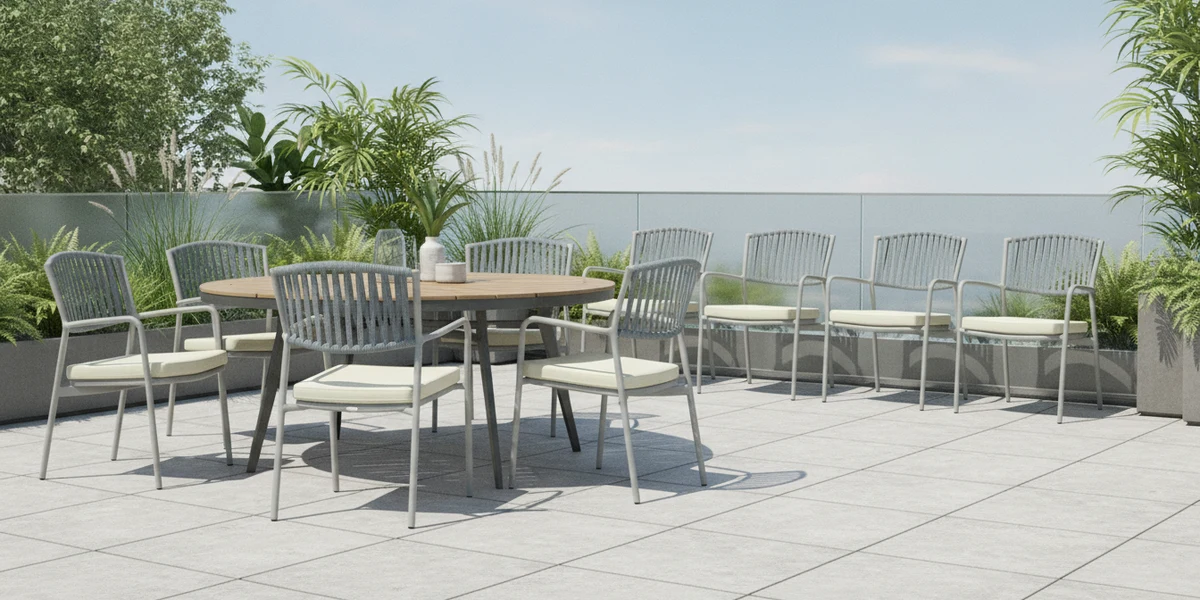
Restaurant Chair Selection Guide: Durability and Comfort

How to choose a restaurant chair?
When choosing a restaurant chair, comfort, durability, fit with table height and upholstery quality are the priorities. Because the guest needs to sit comfortably for a long time, back support and seat depth matter; and because of intensive use, a contract-grade frame and rust protection (e-coating on metal) are decisive.
Comfort: the guest sits at the table for hours
In the restaurant experience, the guest stays at the table for a long time, so the chair's ergonomics are critical. The right back angle, seat depth and cushion quality determine comfort. Models with armrests offer extra comfort; but for the chair to fit under the table, the armrest height must be compatible with the tabletop.
Comfort also has a commercial side. A guest seated comfortably stays longer and is more inclined to order dessert and coffee; an uncomfortable chair makes them ask for the bill early. Concept therefore drives the choice directly. A venue aiming for fast turnover suits a more upright, simpler seat, while a restaurant built around evening dining benefits from a deeper seat and softer upholstery.
For armrests there is a practical measure: the top face of the armrest should pass comfortably under the tabletop. If it does not, the chair cannot be pushed fully in, service space narrows, and table spacing has to be wider than planned — meaning fewer covers in the same room.
Durability and rust protection
Restaurant chairs are pulled, pushed and cleaned many times a day. A contract-grade frame is essential to withstand this intensity. On metal chairs, cathodic e-coating (KTL) is important for rust protection; metal without e-coating may rust over time with moisture and cleaning water. Aluminium models, on the other hand, do not rust naturally.
In a restaurant, wear comes mostly from service rather than from guests. Through the day the chair is pushed under the table, nudged by a broom, and touched by a wet mop during the evening clean. The fastest-wearing points follow from this: the foot tips, the upper edge of the back where it meets the table, and the front corners of the seat. Once a foot glide wears through, the frame starts to drag directly on the floor — scratching the floor and leaving lasting damage on the frame.
Durability should therefore be considered together with replaceable parts, not just frame material. A chair whose glides can be swapped later is renewed in a couple of minutes years down the line; if they cannot be replaced, the same wear leads you to write off the whole chair.
Fit with the table
A standard restaurant table height is about 75 cm; chairs with a suitable seat height of about 45 cm should be chosen. When chair and table are in the same design language, the venue looks cohesive. Miles Sandalye table and chair collections are designed in compatible dimensions.
The 30 cm gap between them is not arbitrary: it is the clearance that lets a seated person's legs sit comfortably under the table. As seat height rises that clearance narrows and guests knock their knees against the table base; as it falls, the table sits too high and arms are held up. Table and chair should therefore be assessed as a pair, not separately.
The shape of the table base matters as much as height. A single-column base lets you fit more chairs into the same area than a four-legged table, because you never have to shift a chair sideways to avoid a leg at the corner. In a busy dining room that can amount to one extra cover per table.
Upholstery and fabric selection
For restaurant upholstery, stain-resistant, easy-to-clean and durable fabrics should be preferred. In busy venues, water-repellent or faux leather coverings are practical. The upholstery colour is chosen according to the venue's concept and the colours of the tablecloth/floor.
Browse the models covered in this article
Metal Chairs
Frequently Asked Questions
How to choose a restaurant chair?
When choosing a restaurant chair, comfort, durability, fit with table height and upholstery quality are the priorities. Because the guest needs to sit comfortably for a long time, back support and seat depth matter; and because of intensive use, a contract-grade frame and rust protection (e-coating on metal) are decisive.
What is the difference between a fine dining and a bistro chair?
In fine dining, comfort and elegance come to the fore; usually upholstered models with armrests are preferred. In bistro/casual venues, lighter, stackable and practical chairs are used.
Which fabric is more durable on a restaurant chair?
For intensive use, water-repellent, stain-resistant contract fabrics or faux leather are recommended. These materials are advantageous for both hygiene and long life.
Are restaurant chairs also used outdoors?
For outdoors, aluminium (rust-free) or e-coated metal models should be chosen. For upholstery, moisture-resistant fabrics suitable for outdoors are preferred.