Choosing Hotel Chairs: Standards and Durability

What should be considered when choosing hotel chairs?
When choosing hotel chairs, contract (commercial) durability standards, material suited to the area of use, comfort and fit with the brand concept are the priorities. Different areas (lobby, restaurant, poolside, terrace) carry different requirements: rust-free aluminium or e-coated metal outdoors; comfortable upholstered models indoors.
The right chair for each area
In a hotel, areas carry different chair requirements from one another:
Specifying a single model without making this distinction is the most common mistake in hotel projects. A chair in the breakfast room, turning three services a day and constantly pulled and pushed, does not carry the same load as a lounge seat a guest occupies for ten minutes. Likewise a poolside chair meets wet swimwear and sees chlorine and sun together; in the dining room what matters instead is how the upholstery stands up to stains and cleaning.
The right approach is to group areas by usage intensity and humidity, choose a frame suited to each group, but keep the design language common. The guest then sees one identity throughout the hotel, while the operator gets the durability each area actually needs.
- Lobby & reception: Comfortable, stylish models that reflect the brand identity.
- Restaurant & breakfast hall: Contract-durable, upholstered chairs that match the tables.
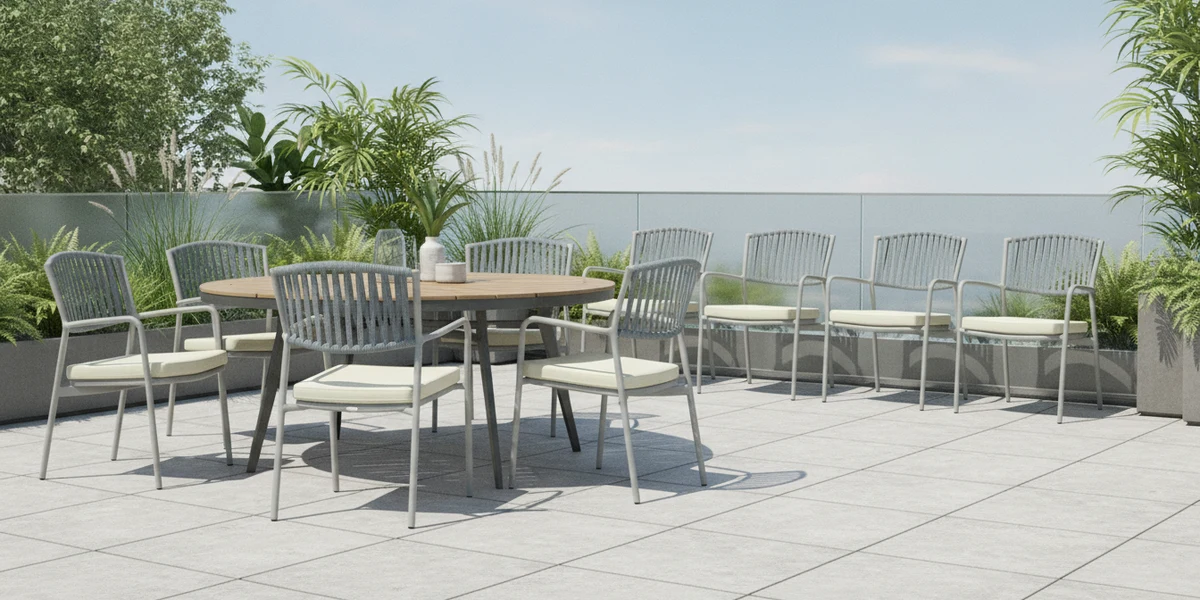
- Poolside & terrace: Rust-free aluminium or e-coated metal, outdoor-resistant models.
- Beach club & seaside: Lightweight aluminium chairs resistant to sun and salty air.
- Bar & rooftop: Bar stools at the right height.
Why is contract durability important?
Hotel furniture is used by hundreds of guests a day. Domestic furniture cannot withstand this intensity; contract (commercial) grade products are needed. On metal models, cathodic e-coating removes the risk of rust in humid areas (pool, spa, open restaurant) and extends the furniture's life.
The difference between contract and domestic grade usually sits where you cannot see it: the number and quality of welds, the reinforcement at joints, the wear resistance of the foot glides. A domestic chair is engineered to be used a few times a day; the same chair in a hotel breakfast room is pulled out hundreds of times daily. The load accumulates at the same points, and a weak joint first loosens, then fails.
For the operator the real cost surfaces here. A broken chair is not just the price of its replacement; it is a table taken out of service during a shift, a visible failure in front of a guest, and the administrative burden of buying replacements one at a time. Contract-grade furniture means not buying those hidden costs in the first place.
Bulk production and project management
Hotel projects generally require high-volume production with planned lead times. Supplying the same model consistently across different areas is important for brand integrity. Miles Sandalye offers high-capacity production, project-specific colour/upholstery and export logistics support for hotel projects.
Browse the models covered in this article
Aluminium Chairs
Frequently Asked Questions
What should be considered when choosing hotel chairs?
When choosing hotel chairs, contract (commercial) durability standards, material suited to the area of use, comfort and fit with the brand concept are the priorities. Different areas (lobby, restaurant, poolside, terrace) carry different requirements: rust-free aluminium or e-coated metal outdoors; comfortable upholstered models indoors.
Which chair is suitable for a hotel poolside?
For the poolside, rust-free aluminium chairs are ideal in areas directly exposed to moisture. E-coated metal models are also suitable for outdoors.
How does the bulk ordering process work in hotel projects?
Once model, quantity, colour and upholstery information is shared, a price and lead-time plan is prepared. Planned production and phased delivery can be arranged for high-volume projects.
Can the same chair model be used in different areas of the hotel?
Yes; the same series can be used in different areas for brand integrity. For outdoor areas, the rust-free/e-coated variants of the same series are preferred.